Not Just Hotter: Where in Britain Are We Breathing the Worst Air During Heatwaves?
As Britain swelters through another heatwave, most headlines focus on high temperatures, public health alerts and overloaded transport systems. But there’s another part of the story that matters just as much for our health: what the air is like on those hot days.
Using over 640,000 survey observations from Understanding Society: The UK Household Longitudinal Study, linked to detailed environmental data, I looked at how often people across Britain experienced both:
- Heatwave conditions – days with maximum outdoor temperature ≥25°C, and
- High NO₂ – people living in neighbourhoods (LSOAs) where the annual maximum nitrogen dioxide (NO₂) concentration is ≥30 μg/m³, used as an indicator of long‑term traffic-related air pollution.
In other words, the NO₂ measure reflects the typical air quality of the neighbourhood, rather than day‑to‑day fluctuations in pollution.
The question was simple: where in Britain do heatwaves occur in places with consistently higher traffic related air pollution?
A double exposure problem – but not for everyone
Across all regions combined, about 5.3% of observation days in the data were heatwave days (≥25°C) experienced by people living in high NO₂ neighbourhoods (annual maximum ≥30 μg/m³). That’s roughly one in twenty person days.
But this average hides very large regional differences.
How often do heatwaves occur in high NO₂ areas?
The figure below shows, for each region, the percentage of observation days where people were interviewed on a heatwave day while living in a neighbourhood with high annual NO₂ (≥30 μg/m³).
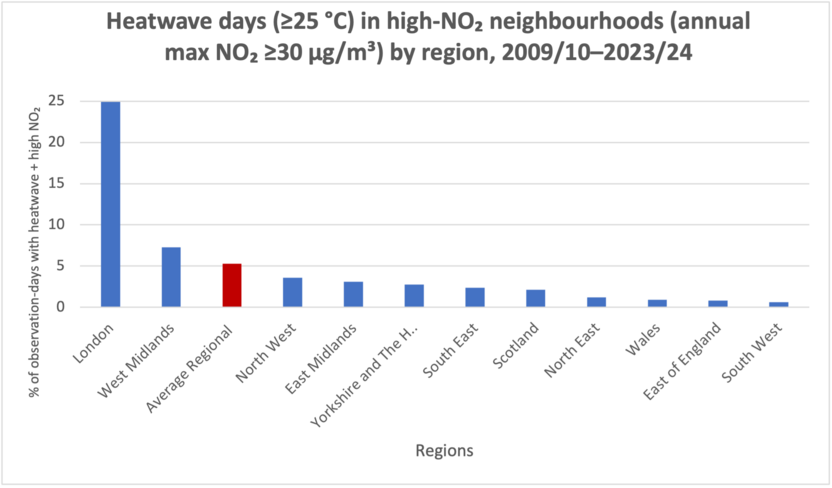
Figure 1. Share of heatwave days (≥25°C) occurring in high NO₂ neighbourhoods (annual maximum NO₂ ≥30 μg/m³), by UK region. Bars show the percentage of survey observation days between 2009 and 2023 where respondents were interviewed on a heatwave day while living in a neighbourhood with high annual NO₂. “Average regional” is the mean across all regions.
As Figure 1 makes clear, London is a complete outlier.
- In London, almost one in four observation days (around 25%) were recorded on heatwave days experienced by people in high NO₂ neighbourhoods.
- The West Midlands is the next highest, with about 7% of days involving this double exposure.
- The average across all regions – the “Average regional” bar – is roughly 5%.
Other regions sit well below this average:
- The North West, East Midlands and Yorkshire and The Humber show moderate levels of double exposure (around 3–4% of days).
- In contrast, the South West, East of England, Wales and the North East see far fewer heatwave days in high NO₂ neighbourhoods – typically less than 1% of observation days.
In practical terms, this means that during the recent heatwaves, London residents are far more likely to be breathing dirty air while they’re overheating than people in, say, the South West or rural Wales.
Why do London and the West Midlands look so different?
These patterns reflect how cities, traffic and weather systems interact.
- Urban heat islands. Big urban regions like London and the West Midlands have dense built environments, fewer trees and a lot of heat retaining surfaces. They cool more slowly at night and amplify daytime heat, making heatwaves more severe.
- Traffic-related pollution. In our data, high NO₂ reflects neighbourhoods with higher long term traffic-related pollution (annual maximum NO₂). NO₂ is largely emitted by road traffic. High traffic density, major road networks and congestion mean that on hot, still days, pollution accumulates rather than disperses.
- Weather that traps pollution. The same high pressure systems that give us clear skies and high temperatures can trap pollutants near the ground, particularly in cities. So the days when it is hottest are also often the days when the air is most polluted.
Put together, this means that in places like London and the West Midlands, people are repeatedly exposed to two stressors at once: heat and poor air quality.
Why this matters for health
In my ETHOS research entitled “Environmental Co-occurrences and General Health: Evidence of Synergistic Heatwave–Air Pollution Effects in Urban Areas,” I find that:
- On their own, heatwaves and NO₂ each have modest average effects on self‑rated general health.
- However, when they co‑occur, the association with health becomes more negative: higher NO₂ is more strongly linked to worse self‑rated health on heatwave days than on cooler days.
- This pattern is clearest in urban areas, where those “double exposure” days are most common.
The individual‑day changes in health scores are small—we’re not talking about dramatic, immediate collapses in wellbeing. But the effects are:
- Systematic (they appear consistently across models and definitions), and
- Cumulative, because millions of people experience these conditions repeatedly across summers and across years.
From a public health perspective, the issue isn’t just that some regions are hotter, or more polluted. It’s that in some regions, especially London and the West Midlands, heat and dirty air often hit at the same time, amplifying each other’s impact.
Inequalities in who bears the burden
These regional differences overlay existing social and health inequalities. Densely populated urban areas often have:
- Higher levels of deprivation.
- More people living in small flats or older housing.
- Less access to green space or cool, clean refuges.
In London and parts of the Midlands, this means more frequent heat + NO₂ days, and more residents with fewer resources to cope—older adults, people with chronic health conditions, and those in insecure work or poor-quality housing.
What should we do differently?
If we take this seriously, it has implications for how we plan and respond to heatwaves:
- Combine heat and air pollution alerts: Public warnings could highlight heatwaves in areas known to have higher traffic‑related NO₂, especially in London and the West Midlands.
- Targeted support in high‑risk regions: Cooling centres, shaded public spaces, and clean indoor air options should be prioritised in neighbourhoods that repeatedly face heat and pollution days.
- Traffic and urban planning measures: Reducing traffic emissions on forecast heatwave days (through low emission zones, traffic restrictions, or public transport incentives) could directly cut NO₂ peaks when they matter most, particularly in high‑NO₂ neighbourhoods.
- Long‑term adaptation: Urban greening, reflective surfaces, and better building standards can reduce both heat and pollution exposure over the long term.
As heatwaves become more frequent under climate change, where you live in Britain will increasingly shape not just how hot it feels, but how healthy it is to be outside on those days. Recognising that some regions face a double burden of heat and dirty air is the first step towards designing fair, place‑sensitive responses.